Opens in a new tab
SearchEventsJoin Our CommunityCommunity
  • Donate Now
  • Donate

    Redefining “Inspiring”

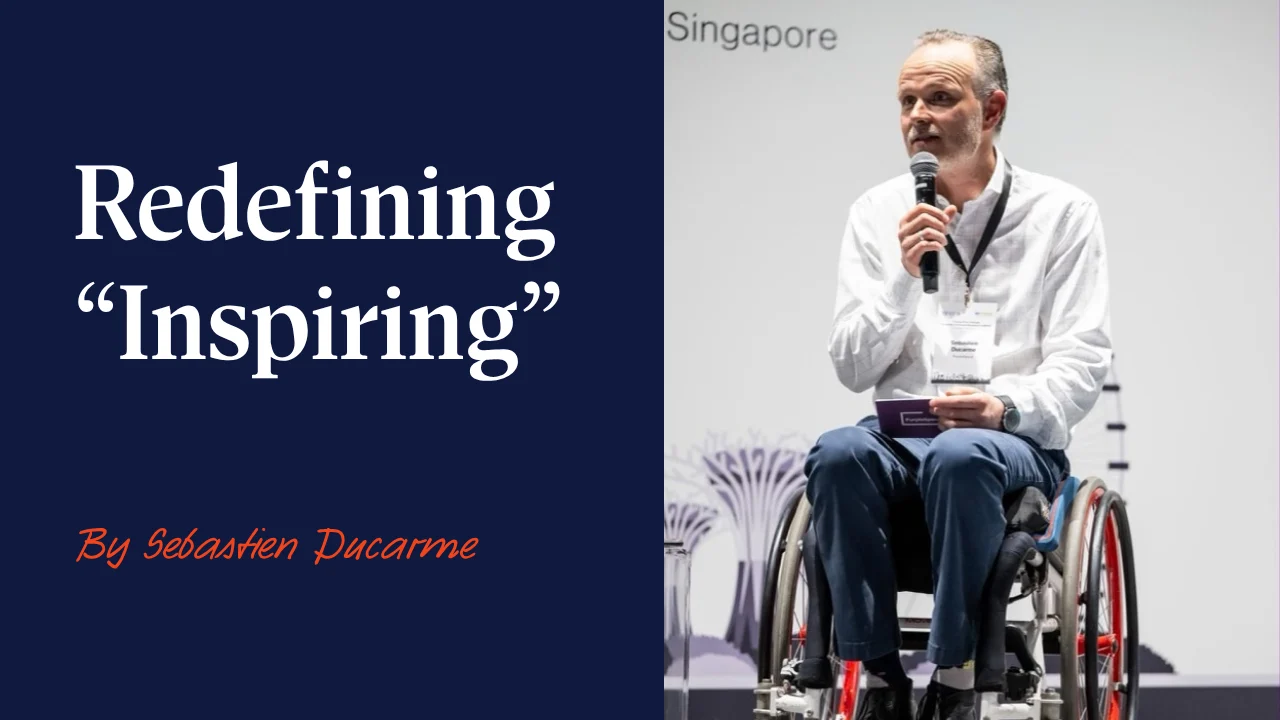
    Seb, seated in his wheelchair, speaking on stage at a disability-inclusive business event in Singapore, 2025.

    My name is Sébastien Ducarme, though most people know me as Seb. When I was 18, a carefree dive into shallow water off a beach in Portugal left me with an incomplete spinal cord injury. That was thirty years ago. Since then, one word has followed me more than any other whenever people hear my story. That word is “inspiring”.

    One of the most unexpected and rewarding parts of my disability journey has been the chance to support and, yes, to inspire others. Over time, though, I have been thinking more deeply about what the word “inspiring” actually means, and how useful it is for the wider disability conversation. So, this is an insight into how I define inspiration at this point in my life, and what I would love it to lead to.

    The story behind the definition

    How I understand the word “inspiration” was shaped long before my accident, by my grandmother, Mutti. She lost her sight gradually to an eye condition until she was completely blind by her mid-forties, yet she never let the darkness extinguish her light. I remember summers with her in Bremen, Germany, playing hide and seek. Thanks to her great hearing she would find us anyhow. She did not simply adapt to her blindness, she thrived. She also accepted help without ever treating it as weakness. My grandfather, Vati, became her eyes on the world, reading her the newspaper and describing every landscape on their travels. Watching them taught me, long before I could put it into words, that real strength has very little to do with what a person can no longer do, and that it grows from the inside out, with the right people beside you.

    I carried that lesson into my professional life. Between the ages of 27 and 47, I worked in clinical research and pharmaceutical product development, first in Germany and France and then, from 2012, in Australia, where I spent twelve years at Roche. Being open about my disability in corporate environments did not come easily. Early on, I kept the harder parts hidden, like planning every journey around access to a toilet, or slipping away mid-conference to change my clothes and saying nothing about why. Over time, I noticed that the moments I was honest about what I needed were the moments things started to change, for me and often for the people around me.

    In 2024, my role was made redundant. After twenty years in the corporate world, I decided to pivot and take these learnings into a new role with a social business called PurpleSpace, a global leadership development hub for disability network and employee resource group leaders. There, we build confidence from the inside out, which is really Mutti’s lesson applied to the workplace. Confidence and inspiration, I have learnt from both my personal and professional experiences, work the same way. Neither one means much unless it starts from within.

    What I think “inspiring” should mean

    For me, disability has been both a battleground and an opportunity to reinvent myself. What I mean by this, is that my incomplete spinal cord injury has forced me to deal with limitations, pain and uncertainty. I had to learn to walk again between parallel bars, and thirty years on I still fall more often than I would like. But it has also been a catalyst for change. It pushed me to study abroad in Salamanca, to complete a master’s in health sciences researching quality of life after spinal cord injury, and to build a family and a career across three countries.

    For a long time, I hesitated to share any of this. I assumed my story was mine alone, a burden no one else wanted to carry. I wrote and published my book “Breaking Through: From Paralysis to Purpose” to mark thirty years since my accident, and because I learned that our everyday stories, even the difficult and unremarkable ones, hold real power. I wrote it for people living with disability, for the families and friends beside them, and for employers who want to build truly inclusive workplaces.

    What I now realise, over years of sharing my story more publicly, is that inspiration is not about bravery or overcoming misfortune. It is about the raw, unfiltered humanity that goes through something hard and comes out changed for the better.

    I think too about how often we celebrate only the extraordinary and heroic version of a story, the “happy, shiny and nice” narrative, while the quieter, everyday struggles and the tenacity that shape a life get far less room. It is in those everyday moments that I believe we find the truest, most useful kind of inspiration, and often the strongest case for change.

    My intention in sharing my story has never been to draw admiration or sympathy. What I hope for instead is to inspire others to face their own challenges and become change agents in their own lives, and in the world around them.

    From feeling moved to taking action

    Advocating for myself, and for the disability community, has taught me that real progress rarely comes from admiration alone. It comes from taking charge of the narrative and moving people from feeling moved towards actually doing something. A few moments have shown me what that looks like in practice.

    Advocating for myself. When I joined a clinical research organisation in my late twenties, I was clear about my conditions from the start: I would need to work from home and live somewhere warmer. To my surprise, they agreed. That was 2006, long before remote work was common, and it meant I could fit physiotherapy into my week, manage the less visible effects of my injury, and put my energy into my work rather than into getting to the office. It taught me that asking for what you need is not a weakness. It is what makes a sustainable career possible.

    Advocating alongside others. While at Roche, I became an ambassador for Sargood on Collaroy, the Royal Rehab Group purpose-built short-term accommodation for people living with spinal cord injuries on Sydney’s Northern Beaches. I helped raise funds from Roche towards its construction and worked with a team, many of them living with spinal cord injuries themselves, to make sure it was accessible from day one rather than adapted later. “Nothing about us without us” was not a slogan there, it was how the place was built. My family and I still go back regularly.

    Seeing perceptions shift. Through The Valuable 500’s Generation Valuable programme, I was paired with a senior global leader in a reciprocal mentoring relationship. I learnt a great deal about strategy and culture, and in return I shared what it really means to work full time with a disability. By the end, we were both talking less about awareness and more about what allyship looks like in action. And after one presentation about my experiences, a senior leader approached me to share that they had lived with a hidden disability for over a decade and had never felt safe talking about it at work. Hearing my story gave them the courage to start.

    Those are the moments I mean when I talk about inspiration. Not a nice feeling, but a first step.

    Turning a compliment into a conversation

    So, when people tell me my story is inspiring, I try to hold on to what I want that word to mean, and I ask them to help me get there with a question or two:

    How did it inspire you to think differently?

    What did it actually inspire you to do?

    It is a small shift, but it turns a compliment into something we can both act on, rather than a nice feeling that ends the moment it is said.

    The answers that stay with me are never the ones that simply say the book was moving. They come from readers who tell me it pushed them to face a hard conversation, a decision they had been avoiding, or a part of themselves they had not yet accepted. That is what inspiration is meant to do. It should set off a chain reaction of connection and change, not leave people watching from a distance.

    Author

    This piece was written by Sébastien Ducarme, a global disability inclusion advocate, leadership coach and clinical research professional. He is the author of Breaking Through: From Paralysis to Purpose, a personal reflection on acquiring a SCI at 18 and how that experience shaped his life. Sébastien is also the Membership Engagement Manager and FutureMaker Lead at PurpleSpace. To learn more about Seb please visit sebastienducarme.com
    Seb, seated in his wheelchair, speaking on stage at a disability-inclusive business event in Singapore, 2025.

    My name is Sébastien Ducarme, though most people know me as Seb. When I was 18, a carefree dive into shallow water off a beach in Portugal left me with an incomplete spinal cord injury. That was thirty years ago. Since then, one word has followed me more than any other whenever people hear my story. That word is “inspiring”.

    One of the most unexpected and rewarding parts of my disability journey has been the chance to support and, yes, to inspire others. Over time, though, I have been thinking more deeply about what the word “inspiring” actually means, and how useful it is for the wider disability conversation. So, this is an insight into how I define inspiration at this point in my life, and what I would love it to lead to.

    The story behind the definition

    How I understand the word “inspiration” was shaped long before my accident, by my grandmother, Mutti. She lost her sight gradually to an eye condition until she was completely blind by her mid-forties, yet she never let the darkness extinguish her light. I remember summers with her in Bremen, Germany, playing hide and seek. Thanks to her great hearing she would find us anyhow. She did not simply adapt to her blindness, she thrived. She also accepted help without ever treating it as weakness. My grandfather, Vati, became her eyes on the world, reading her the newspaper and describing every landscape on their travels. Watching them taught me, long before I could put it into words, that real strength has very little to do with what a person can no longer do, and that it grows from the inside out, with the right people beside you.

    I carried that lesson into my professional life. Between the ages of 27 and 47, I worked in clinical research and pharmaceutical product development, first in Germany and France and then, from 2012, in Australia, where I spent twelve years at Roche. Being open about my disability in corporate environments did not come easily. Early on, I kept the harder parts hidden, like planning every journey around access to a toilet, or slipping away mid-conference to change my clothes and saying nothing about why. Over time, I noticed that the moments I was honest about what I needed were the moments things started to change, for me and often for the people around me.

    In 2024, my role was made redundant. After twenty years in the corporate world, I decided to pivot and take these learnings into a new role with a social business called PurpleSpace, a global leadership development hub for disability network and employee resource group leaders. There, we build confidence from the inside out, which is really Mutti’s lesson applied to the workplace. Confidence and inspiration, I have learnt from both my personal and professional experiences, work the same way. Neither one means much unless it starts from within.

    What I think “inspiring” should mean

    For me, disability has been both a battleground and an opportunity to reinvent myself. What I mean by this, is that my incomplete spinal cord injury has forced me to deal with limitations, pain and uncertainty. I had to learn to walk again between parallel bars, and thirty years on I still fall more often than I would like. But it has also been a catalyst for change. It pushed me to study abroad in Salamanca, to complete a master’s in health sciences researching quality of life after spinal cord injury, and to build a family and a career across three countries.

    For a long time, I hesitated to share any of this. I assumed my story was mine alone, a burden no one else wanted to carry. I wrote and published my book “Breaking Through: From Paralysis to Purpose” to mark thirty years since my accident, and because I learned that our everyday stories, even the difficult and unremarkable ones, hold real power. I wrote it for people living with disability, for the families and friends beside them, and for employers who want to build truly inclusive workplaces.

    What I now realise, over years of sharing my story more publicly, is that inspiration is not about bravery or overcoming misfortune. It is about the raw, unfiltered humanity that goes through something hard and comes out changed for the better.

    I think too about how often we celebrate only the extraordinary and heroic version of a story, the “happy, shiny and nice” narrative, while the quieter, everyday struggles and the tenacity that shape a life get far less room. It is in those everyday moments that I believe we find the truest, most useful kind of inspiration, and often the strongest case for change.

    My intention in sharing my story has never been to draw admiration or sympathy. What I hope for instead is to inspire others to face their own challenges and become change agents in their own lives, and in the world around them.

    From feeling moved to taking action

    Advocating for myself, and for the disability community, has taught me that real progress rarely comes from admiration alone. It comes from taking charge of the narrative and moving people from feeling moved towards actually doing something. A few moments have shown me what that looks like in practice.

    Advocating for myself. When I joined a clinical research organisation in my late twenties, I was clear about my conditions from the start: I would need to work from home and live somewhere warmer. To my surprise, they agreed. That was 2006, long before remote work was common, and it meant I could fit physiotherapy into my week, manage the less visible effects of my injury, and put my energy into my work rather than into getting to the office. It taught me that asking for what you need is not a weakness. It is what makes a sustainable career possible.

    Advocating alongside others. While at Roche, I became an ambassador for Sargood on Collaroy, the Royal Rehab Group purpose-built short-term accommodation for people living with spinal cord injuries on Sydney’s Northern Beaches. I helped raise funds from Roche towards its construction and worked with a team, many of them living with spinal cord injuries themselves, to make sure it was accessible from day one rather than adapted later. “Nothing about us without us” was not a slogan there, it was how the place was built. My family and I still go back regularly.

    Seeing perceptions shift. Through The Valuable 500’s Generation Valuable programme, I was paired with a senior global leader in a reciprocal mentoring relationship. I learnt a great deal about strategy and culture, and in return I shared what it really means to work full time with a disability. By the end, we were both talking less about awareness and more about what allyship looks like in action. And after one presentation about my experiences, a senior leader approached me to share that they had lived with a hidden disability for over a decade and had never felt safe talking about it at work. Hearing my story gave them the courage to start.

    Those are the moments I mean when I talk about inspiration. Not a nice feeling, but a first step.

    Turning a compliment into a conversation

    So, when people tell me my story is inspiring, I try to hold on to what I want that word to mean, and I ask them to help me get there with a question or two:

    How did it inspire you to think differently?

    What did it actually inspire you to do?

    It is a small shift, but it turns a compliment into something we can both act on, rather than a nice feeling that ends the moment it is said.

    The answers that stay with me are never the ones that simply say the book was moving. They come from readers who tell me it pushed them to face a hard conversation, a decision they had been avoiding, or a part of themselves they had not yet accepted. That is what inspiration is meant to do. It should set off a chain reaction of connection and change, not leave people watching from a distance.

    Author

    This piece was written by Sébastien Ducarme, a global disability inclusion advocate, leadership coach and clinical research professional. He is the author of Breaking Through: From Paralysis to Purpose, a personal reflection on acquiring a SCI at 18 and how that experience shaped his life. Sébastien is also the Membership Engagement Manager and FutureMaker Lead at PurpleSpace. To learn more about Seb please visit sebastienducarme.com
    Search SCIA: