
Featured
Featured
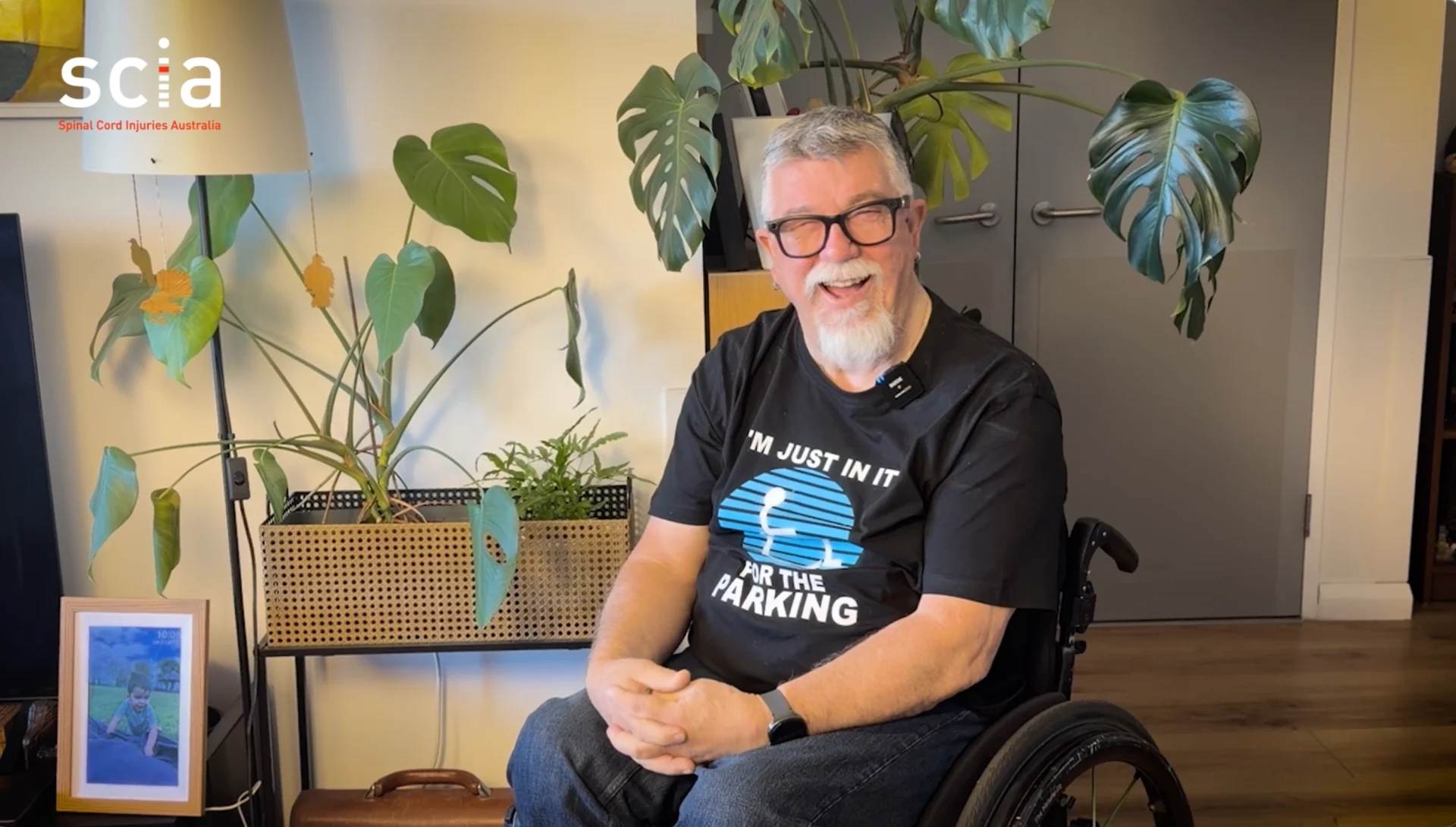



For Stuart, independence is one of the most important things in life. Following a motorcycle accident while travelling in Nepal, which resulted in a spinal cord injury and traumatic brain injury, he has found new ways to continue doing the things he enjoys, including travelling, spending time with family and staying active in his community.
In this episode of One in Five, produced in collaboration with Spinal Cord Injuries Australia and NeuroMoves, Stuart shares his experience of living with disability, the role patience and positivity have played in his journey, and how NeuroMoves has become an important part of his routine.
Thank you to Stuart for sharing his story with such openness and generosity.
One in Five: Episode Two with Poonam Shah
SpinalCordInjuriesAustralia
August 24, 2026 1:01 pm
Feeling, I should say that I can do whatever I want. Independence is the biggest thing for me. And the fact that I’ve got independence and I’ve got a car, I can fly, it’s just amazing. Life for me is good. So, yeah, I’m really, really happy.
Hi guys, I’m Stuart. I’m a 63 year old, complete T-10, and I’ve been living where I live now for the last five years. I lived in New Zealand for 30 odd years, and my second marriage broke up like my first marriage. When it broke up, I needed to get out. I came to Australia for ten months. After the second marriage, I decided ‘bugger it I’m going off to travel the world’, and I had was in Nepal and I was doing some volunteer work at a school over there.
Then I decided to go up to Pokhara to buy an Indian motorcycle, Royal Enfield, and woke up nine months later in Royal North Shore Hospital. Fortunately, my brothers here in Australia are switched on and one of the brothers flew to Nepal the next day, got to the hospital in Kathmandu and rang my niece, who was the Consulate General in Dubai. And so she had me moved to Bangkok.
I was in Bangkok Hospital for a month and then from there I was back to Sydney and as I said, I woke up nine months later in Royal North Shore. From there I went to Royal Rehab in Ryde and took a couple of times to get there. But I finally was there and I was in the brain injury unit for 14 months because I had a fairly severe TBI (traumatic brain injury). And then yeah, now here I am.
The first real memory I had was January 17th 2019. Two of my kids who flew across New Zealand, from New Zealand I should say, and dragged me out to a pub in Saint Leonards to have lunch. And I remember that and I don’t remember Royal Rehab, just bits and pieces, not the whole thing.
Whereas I’ve got a very good long-term memory and fortunately after the accident, I’ve still got it. The best thing for me is that I’ve got my brain back and that’s the main thing for me. And now I can travel again, which I used to be a traveller. I used to work in Europe as a tour guide and that’s why on my arm here I’ve got ‘Travel is my therapy.’
Research, research, research. That’s all I have to do now is I’ve been to New Zealand to see my family and my kids and my grandkids. I’ve been to Singapore, then to London, then been up to Norway again. I’ve been to Norway three times now, but went back to see the northern lights. And then last year I flew up to Canada or via the States, flew up to Canada, then up to Alaska.
I used to fly regularly in New Zealand in a helicopter and that’s the biggest thing for me. I thought I’d never be able to do that again. And when I was in Alaska, I found a company that could fly me up to the Hubbard Glacier. And so I did that. I now can fly again in a helicopter, and I’ve done that. I’ve done a lot, of, lot, lot more travel now.
The biggest challenge to start with was starting life again with my family in New Zealand. I can’t go there or I can’t reside there anymore. I think looking back and looking at it now, I think I’m possibly better off here in Australia because of the quality of the NDIS and the health services here.
Patience is the biggest thing. And funnily enough, I was doing a talk last week at Royal Rehab and one of the patients there or the women there who was a patient, she had a brain injury and she was a mother, and she took a lot out of what I was saying about if I had the brain injury and the paraplegia prior to having kids, I’d be a far better father, because now I’ve got so much patience in comparison to what I used to have, but I think it’s just given me so much inner strength to be able to advocate and just to the patience. I’m extremely comfortable in life in my head and given where my head was. You’ve got no idea how far I’ve come.
I was introduced through one of the medical people for the neurological side at Liverpool Hospital. They put me on to NeuroMoves and got me involved that way. So I remember I went out to NeuroMoves, which was at Prestons. I told my story and … how I had the accident and did some testing and stuff like that. So they said, yeah, we’ll take you on. So through my NDIS, they cover the cost. And when I finally came to this place here, which I then relocated to Saint Peters, and I’ve been going to Saint Peters now twice a week, which is that’s an amazing service.
They are really, really good. And NeuroMoves is just a godsend. So now I get into NeuroMoves they put me on a motor med, which is a mechanical machine that moves my legs around like riding a bicycle, which ever since then I haven’t had swollen ankles. I find NeuroMoves is a community, which I really enjoy, and the people there are fantastic, and they really look after me and I try and give them some of you.
I’ve managed to drag myself out of where I was and I think it’s just down to being positive. So that’s why now I’m, I’m still I’m very positive and I just wish everybody else can see that. And not only me, but in themselves, that there is some value in being positive about life because there are a lot of good things and there are good people in life.
NeuroMoves is a specialised exercise physiology and physiotherapy service for people with disability and neurological conditions. Find out more about how they can help you, or a loved one, by visiting the NeuroMoves website.

One in Five: Episode Three with Nicki Anne Antonio
SpinalCordInjuriesAustralia
September 4, 2026 9:15 am